
Block Drop: the 7-bag, hold and lock delay explained
Most of what makes a falling-block game feel fair happens where you cannot see it: in how the next pieces are chosen, how long a piece waits on the stack before it locks, and how a rotation squeezes a piece into a gap. Block Drop follows the modern conventions for all three. Knowing how they work turns “the game hates me” into plans you can actually make.
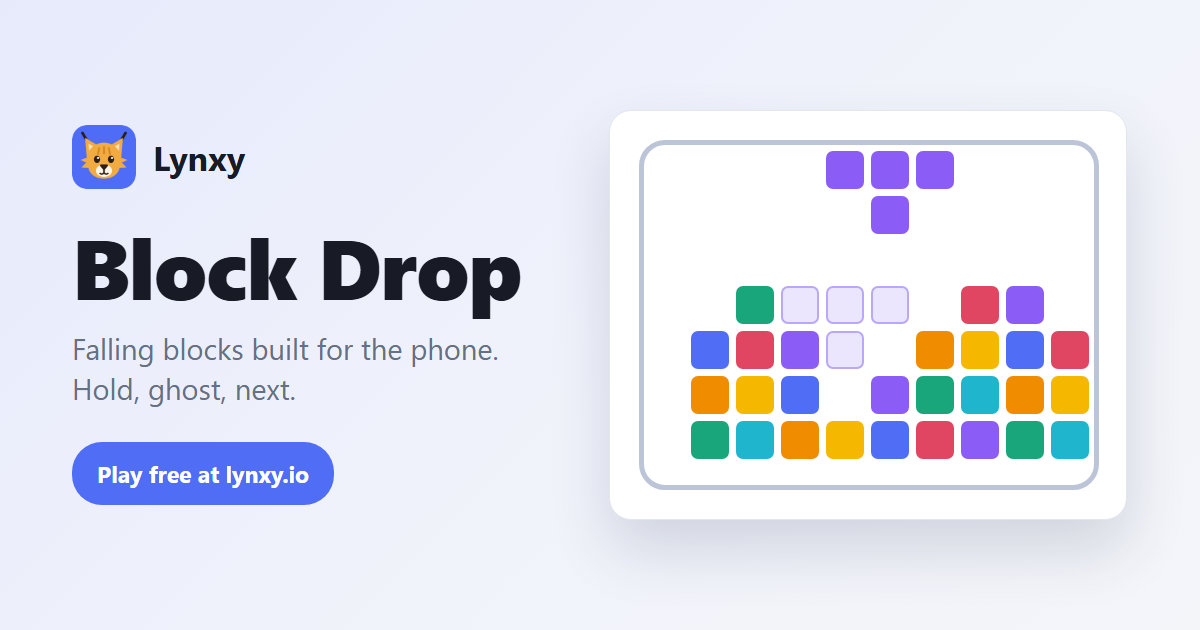
The 7-bag: why you never wait forever for the long piece
There are seven pieces, each made of four squares: the long I, the square O, and T, S, Z, J and L. A naive game would pick each next piece at random, and with pure chance you can go twenty or thirty pieces without seeing an I. Everyone who has played an old falling-block game remembers that feeling.
Block Drop uses a 7-bag instead. Put one of each piece in a bag, shake it, and deal them out in that order. When the bag is empty, fill a new one. Every run of seven pieces holds each shape exactly once. That has two consequences you can count on:
- The longest you can wait for any piece is 12 pieces. That happens only when it comes first in one bag and last in the next.
- The same piece can never come more than twice in a row - last in one bag, first in the next. Three S pieces in a row cannot happen.
It also means the queue gives away more than it seems. The game shows the next three pieces. If you can count where a bag started, you know which pieces are still to come before the next shuffle. You do not need to do this consciously; just knowing that an I is never more than a dozen pieces away makes it reasonable to keep a column open for it.
Hold: one swap per piece
Hold puts the current piece aside and brings in the one you held before (or the next piece, the first time). You can hold once per piece - after a swap, hold is locked until the new piece lands.
The most common use is to keep an I in hold while you build up a stack with a single-column gap, then swap it in for four lines at once. The second most common is getting rid of an awkward S or Z when there is nowhere clean to put it. Both work better when you treat hold as a slot that should almost always be full: an empty hold is a choice you have not used yet.
Lock delay: the half second that saves you
When a piece touches the stack, it does not lock at once. It waits 500 milliseconds, and the piece fades as that time runs out. Every move or rotation during that wait restarts it, up to 15 times. If the piece drops to a lower row than it has been on before, the counter of restarts is reset too.
This matters more than anything else on the later stages, because the fall speed keeps rising but the lock delay does not. Every ten lines the stage goes up and the time a piece takes to fall one row is multiplied by 0.85:
| Stage (lines) | Easy | Medium | Hard |
|---|---|---|---|
| 1 (0-9) | 800 ms | 480 ms | 260 ms |
| 3 (20-29) | 578 ms | 347 ms | 188 ms |
| 5 (40-49) | 418 ms | 251 ms | 136 ms |
| 8 (70-79) | 256 ms | 154 ms | 83 ms |
| 11 (100-109) | 157 ms | 94 ms | 51 ms |
| 15 (140-149) | 82 ms | 50 ms | 50 ms |
A few things are worth reading out of that table. Easy reaches the speed Hard starts at after 70 lines. Medium gets there after 40. Hard hits the floor of 50 ms per row - twenty rows a second, the piece is at the bottom almost before you see it - after 110 lines.
At that point the game is played almost entirely inside the lock delay. The piece arrives on the stack instantly, and you have half a second, renewed with each move, to slide and turn it into place. The skill that carries you through the late stages is not reacting faster; it is deciding where the piece goes before it appears, using the three-piece preview.
Wall kicks: rotations that work against the wall
Try to rotate a piece flat against a wall or the stack, and a simple game would just refuse. Block Drop tries a short list of alternative positions instead - a column or two to the side, a row up or down - and uses the first one that fits. These are the official wall-kick tables of the standard modern rotation system, with a separate table for the I piece, which is longer and kicks further.
Kicks are why you can rotate a piece that is already touching the left wall, and why a T piece can twist into a slot that looks too narrow for it. They also explain the occasional surprise rotation that pops a piece up and over a ledge. If a rotation does something odd, it was a kick, and it was the first position on the list that fitted.
Scoring: why four lines at once pay twice
| Lines at once | Easy | Medium | Hard | Per line |
|---|---|---|---|---|
| 1 | 1 | 2 | 3 | 1× |
| 2 (“Double”) | 3 | 6 | 9 | 1.5× |
| 3 (“Triple”) | 5 | 10 | 15 | 1.67× |
| 4 (“Quad!”) | 8 | 16 | 24 | 2× |
A Quad is worth twice as much per line as four singles. That is the whole case for building a tall, flat stack with one empty column and waiting for an I - and the 7-bag is what makes the wait safe. On the other hand, a stack is only worth building while it is low. When it climbs past the middle of the well on a fast stage, take the singles and doubles and get it back down. A game that ends at 60 lines scores less than one that survives to 120 with no Quads at all.
A simple plan that works
- Keep the stack flat. Bumps of more than two rows next to each other leave holes for S and Z pieces you will not want to fill.
- Leave one column open, at the right or left edge, for an I piece.
- Keep an I in hold when you can. If the queue has no I and your column is ready, hold the awkward piece instead.
- Look at the queue, not the falling piece. By the time a piece appears, you should already know where it goes.
- Know when to hard-drop. A hard drop locks the piece at once - no lock delay. Use it when the piece is already above its spot. When it still needs a slide or a twist at the bottom, let it fall (or soft-drop) and use the half second on the stack instead.
On a phone, a tap on the well rotates, a drag moves one column per cell of travel, a flick down hard-drops and a flick up holds. The on-screen pad does the same with buttons. Whichever you use, the rules above are the same.
← All guides