
How par works in Gem Cascade, and how to get three stars
Gem Cascade never ends a level because you ran out of moves. There is no move limit at all: you keep swapping until every goal is met. What the moves decide is your stars - and the number that decides them, par, was not picked by hand. A bot played every designed level forty times, and par came out of its results.
Three stars, two stars, one star
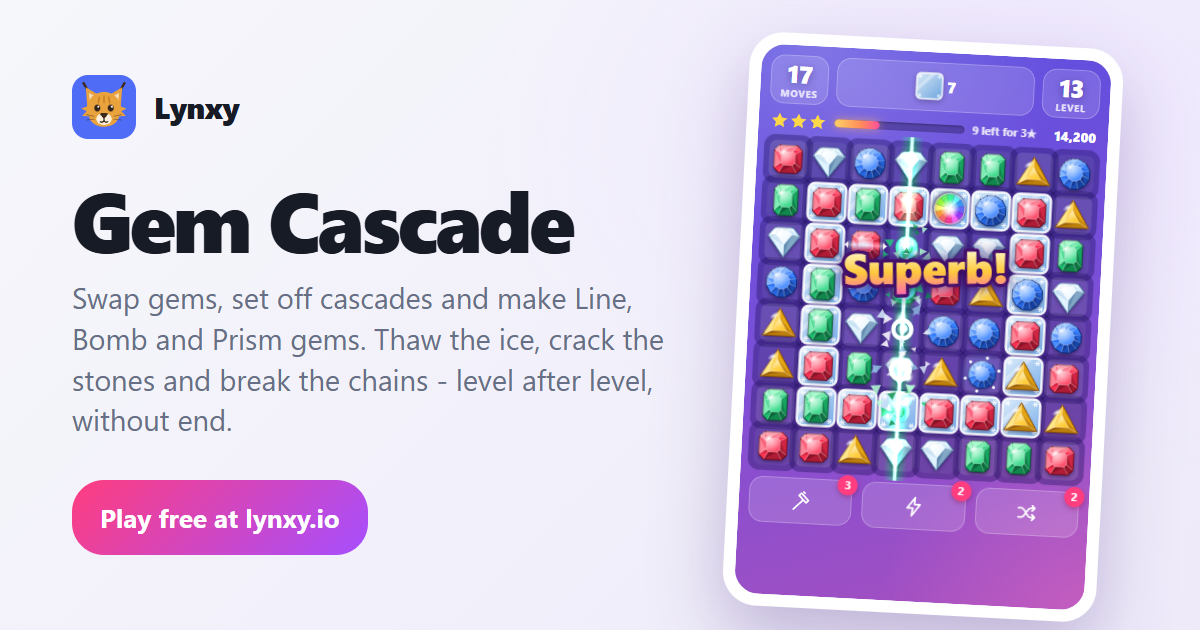
Every level has a par: a number of moves. Finish within par and you get three stars. Finish within 1.4 times par (rounded up) and you get two. Finish at all and you get one. The meter under the score shows the stars you would get right now and how many moves you have before the next one is lost.
A swap that lines nothing up slides back and costs nothing, so you can try ideas freely. Only a swap that actually clears something counts as a move.
Level 1 has a par of 18, so three stars need 18 moves or fewer and two stars need 26 or fewer. The longest pars among the fifty designed levels are 46 moves (levels 46, 47 and 49); the shortest is 12 (level 9), on a small board where every move matters.
How par was set
We did not want par to be a guess. A tool plays every designed level with a simple bot: on each turn it looks at every possible swap, picks the one that does the most for the level's goals right now, and moves on. It sees the board, but - just like you - not the gems that are going to fall in from the top. It plays each level forty times with different random gems.
Par is then set from how often the bot manages to finish within it:
| Levels | The bot finishes within par in… |
|---|---|
| 1-5 | 97% of games |
| …rising difficulty… | … |
| 31-50 | 70% of games |
So on the first levels, par is generous - the bot almost always makes it. By the last designed levels it fails three times in ten. The bot is greedy and never plans more than one move ahead, which is exactly the weakness a human can beat: a player who sets up special gems and combinations on purpose should be able to do better than a machine that only takes what is in front of it.
After level 50 the levels are generated from their number - the same number always gives the same level, for everyone. Their par comes from a formula fitted to the same bot's results on a large sample of generated levels: so many moves per layer of ice, per stone, per chain, per gem to collect, and a little extra when all six colours are in play. Difficulty keeps rising until level 300 and then stays there.
Where the points come from
Score goals are part of some levels, so it helps to know how the score is counted:
- Each gem in a match is worth 20 points; gems swept away by a special gem's blast are worth 30.
- Cascades multiply that. The first clear after your swap counts once, the first cascade twice, the next one three times, and so on. The words in the middle of the board start at the third clear (“Nice!”) and go up to “Legendary!”.
- Making a special gem adds a bonus: 60 for a Line gem, 100 for a Bomb, 200 for a Prism - multiplied by the cascade too.
- Each layer of ice and each crack in a stone adds 60, each broken chain 40.
A plain match of three is 60 points. The same three gems cleared in the third step of a cascade are worth 180. That is why matches near the bottom of the board are worth more than they look: everything above them falls, and falling gems are what start cascades.
The Gem Rush: why saving moves pays twice
When a level is won, every move you saved under par turns a random gem into a Line gem, adds 250 points, and then every special gem on the board goes off. Beating par by five moves means five extra line blasts plus whatever specials you left lying around. If a level has a high score on your records list, this is usually where it came from.
Special gems and their combinations
The special gems are what lets a human beat the bot. Here is how they are made:
| Match | Makes | What it does |
|---|---|---|
| 4 in a row across | Line gem | Clears its column |
| 4 in a row down | Line gem | Clears its row |
| L or T shape | Bomb | Clears a 3 × 3 square |
| 5 in a row | Prism | Clears every gem of one colour |
Swap two specials into each other and they combine:
| Swap | Result |
|---|---|
| Line + Line | A cross: one full row and one full column |
| Line + Bomb | Three rows and three columns |
| Bomb + Bomb | A 5 × 5 square |
| Prism + Line or Bomb | Every gem of that colour becomes a Line or Bomb, and they all go off |
| Prism + Prism | The whole board |
The Prism + Line combination is the strongest single move on most boards, and it is easy to overlook, because the instinct with a Prism is to use it straight away. A Prism matched normally clears one colour. Swapped into a Line gem, it turns that whole colour into Line gems first. On a board with ice everywhere, that can finish a level in one move.
How to get three stars
- Read the goals before the board. A level that needs 30 sapphires wants you to match sapphires even when a bigger match of another colour is available. A level full of ice wants matches where the ice is.
- Build specials instead of taking the first match. A move that makes a match of three now is often worse than a move that leaves four in a row for next turn.
- Hold on to specials. Two specials side by side are worth more swapped together than set off one at a time.
- Use the boosters on the last move. The Hammer, the Lightning and the Shuffle do not use a move. If the last tile of ice is sitting in a corner where no match can reach it, one Hammer can save three or four moves - and that can be the difference between two stars and three.
- Work from the bottom when you can. Matches low on the board make everything above them fall, which means more free cascades and more points.
Boosters
You start with three Hammers, two Lightnings and two Shuffles. Winning every third level for the first time earns one more booster, and so does the first three-star finish on any level - which one you get rotates from level to level. In other words, chasing three stars refills the very tools that help you get them. When a booster runs out it shows a “+”, and once per level tapping it gives you one more for free. The game never shows you a move as a hint - finding them is the game.
If a board ever has no possible move, it is shuffled for free. A level only ends without a win if no shuffle can find a move at all, and in practice that does not happen.
← All guides