
Nova Bricks power-ups ranked, and the stages that need them
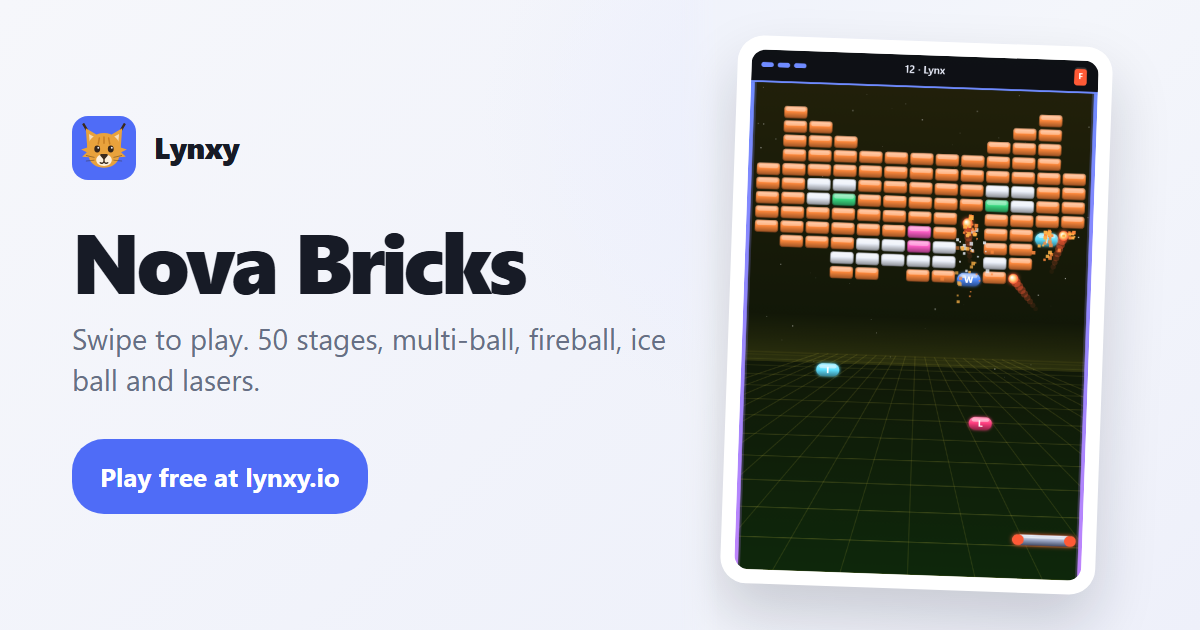
Nova Bricks has nine power-ups, and they are not equal. Some will clear half a stage for you; one will actively try to end your run. Here is how often each one drops, what it really does, and where in the fifty stages it matters most - plus the two checks every stage passes before it reaches you.
How often capsules drop
A mystery brick (purple, with a question mark) always drops a capsule. Any other brick drops one with a chance of one in ten. Which capsule you get is a weighted draw:
| Power-up | Chance | Lasts | |
|---|---|---|---|
| Multi-ball | 18% | until the balls are lost | |
| Wide paddle | 18% | 16 s | |
| Fireball | 11% | 10 s | |
| Ice ball | 11% | 12 s | |
| Lasers | 11% | 10 s | |
| Slow motion | 10% | 12 s | |
| Magnet | 9% | 15 s | |
| Tiny paddle | 8% | 10 s | |
| Extra life | 3% | up to 6 lives |
On an ordinary stage of about 70 bricks you can expect around seven capsules from the bricks alone, plus one per mystery brick. Stage 27, Mystery Box, has 25 mystery bricks, which makes it the one stage where you will see almost every power-up in a single go.
The power-ups, from best to worst
This is our ranking. Yours may differ - but probably not about the last one.
1. Fireball
For ten seconds the ball burns straight through everything it touches, steel included, without bouncing. It is the only power-up (with the ice ball) that can break steel, and in stages built around steel walls it turns a slow grind into a clean sweep. The trick is to aim it: a fireball that goes straight up and comes straight back down only cuts one column. Hit it with the edge of the paddle to send it diagonally through the thickest part of the wall.
2. Multi-ball
Every ball in play splits into three, up to twelve at once. Catch two in a row and you have nine balls. You only lose a life when the last ball falls, so multi-ball is also insurance. Its weakness is that you cannot follow twelve balls; pick one, usually the lowest, and keep that one alive.
3. Ice ball
The ice ball bounces normally, but the brick it hits freezes together with every brick touching it, up to a 3 × 3 block - armour and steel included. Less than a second later the whole block shatters. Ice spreads only through bricks that touch, never across a gap, so it is strongest on dense, packed stages and weakest on scattered pictures. It also flies a little slower, which is a small gift of its own.
4. Lasers
For ten seconds the paddle fires twin beams by itself. Each beam cracks the first brick it meets; steel stops it. Lasers shine at the end of a stage, when three or four lonely bricks are left and the ball keeps missing them. Park under the last brick and let the beams do the work.
5. Wide paddle
The paddle grows by 60% for sixteen seconds. Not exciting, but at the high ball speeds of the late stages, a bigger paddle is the difference between a save and a lost life. Wide and tiny cancel each other - the newer one wins - so a wide paddle is also the cure for the tiny one.
6. Slow motion
Every ball moves 30% slower for twelve seconds. Most useful in exactly the moments when you are too busy to want it - with multi-ball running and a stage that has sped up. Worth catching if it is on your way, not worth a risky dash.
7. Magnet
The ball sticks to the paddle for fifteen seconds. Move to aim, then tap to let it go; it releases by itself after two and a half seconds. The magnet lets you aim every shot, which is great for picking off a specific brick and terrible for your rhythm. Use the release time to line up shots towards the side of the stage that still has the most bricks.
8. Extra life
Rare - three capsules in a hundred - and you can hold up to six lives. It ranks low only because you cannot plan for it. When you see one, it is worth almost any risk to catch.
9. Tiny paddle
The one bad capsule: a narrow paddle for ten seconds. It drops just as often as the good ones (8%), and it looks similar while it falls. Learn its grey colour and the minus sign, and move away from it.
A few combinations are worth knowing. Fireball and ice ball cancel each other, and the newer one wins - so if you have a fireball running in a steel stage, let a falling ice capsule go. Losing a life ends every power-up at once.
Which stages need what
We counted the bricks in all fifty stages. Most are pictures made of coloured bricks that break in one hit. A handful are built to be hard, and those are the ones where the right power-up matters:
| Stage | Coloured | Armoured | Steel | Bombs | Hits needed |
|---|---|---|---|---|---|
| 12 Lynx | 115 | 0 | 0 | 0 | 115 |
| 19 Nested | 80 | 16 | 28 | 0 | ~113 |
| 28 Steel Maze | 88 | 16 | 36 | 0 | ~120 |
| 43 Chess | 62 | 78 | 0 | 16 | ~273 |
| 45 Target | 80 | 16 | 30 | 1 | ~129 |
| 49 Iron Curtain | 39 | 79 | 31 | 12 | ~261 |
| 50 The Core | 0 | 69 | 40 | 32 | ~224 |
“Hits needed” counts every hit it takes to break every breakable brick, ignoring bombs going off. Bombs bring that number down a lot, because each one blows up the eight bricks around it and sets off any other bomb in range.
- Steel stages (Nested, Steel Maze, Target, Iron Curtain, The Core) are where a fireball or an ice ball earns its rank. Without one, the ball spends a long time rattling around steel corridors.
- Armour-heavy stages (Chess, Iron Curtain, The Core) favour multi-ball: many balls hitting many times. Lasers help with the last few three-hit bricks.
- Bomb stages (Bomb Bay, Chess, Iron Curtain, The Core) reward patience. Aim for the bombs first. One well-placed hit on a bomb chain can clear more than a fireball.
The Core, the last stage, has not a single ordinary coloured brick: only armour, steel, 32 bombs and five mystery bricks. It is the stage the whole game was building towards.
Two checks before a stage goes live
Steel brings a risk that the other bricks do not: you can accidentally draw a stage where a breakable brick is completely surrounded by steel. Then, without a lucky fireball, the stage cannot be cleared. A checking tool looks at every stage and makes sure that each breakable brick connects to the open space below through cells that are not steel. Steel itself never counts towards clearing a stage - you never have to break it.
The second check is an autopilot. It plays every stage in a real browser, much faster than real time, with the paddle following the ball, and reports any stage it cannot clear within ten simulated minutes. Steel corridors can trap a ball in a loop that repeats forever, which is why the game also nudges the ball slightly at wall bounces if it has not hit a breakable brick for twelve seconds.
Speed, and why losing a life is not all bad
The ball starts each stage a little faster than the last - three units per second per stage - and speeds up by 0.8% every time it comes off the paddle, up to 25% faster. Losing a life resets that speed. On the long, armoured stages the ball can get very fast before you clear them, and a lost life, painful as it is, also hands you a slower ball. Clearing a stage pays 250 points plus 100 for every life you still have, so lives are worth keeping - but not worth panicking over.
← All guides