
How Pipe Flow boards are grown, and where to start solving them
Every Pipe Flow board starts life solved. The game grows a network of pipes from the tap until it covers the board, and only then turns every piece at random. That is why every board can be finished - and once you know how a board is grown, it also tells you where to start solving it.
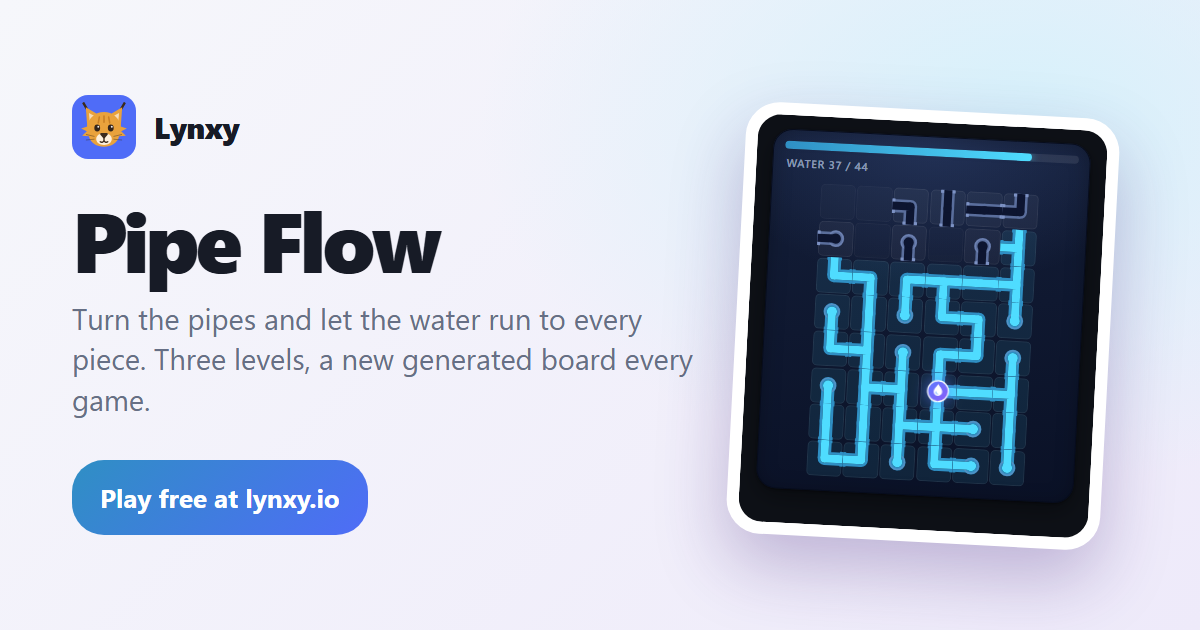
Growing a board backwards
A random scramble of pipe pieces would almost never form a working network. So Pipe Flow builds boards the other way round, in four steps:
- Plant the tap somewhere in the middle third of the grid.
- Grow a tree from it, one connection at a time: pick a cell that is already part of the network, connect it to an empty neighbour, repeat. It stops when the network covers the level's share of the grid.
- Read off the pieces. Each cell becomes whatever junction it ended up as: a cap if it has one connection, a straight or an elbow if it has two, a tee for three, a cross for four. This finished network is the solution.
- Scramble. Every piece is turned at random. A scramble that happens to be solved already, or that needs too few turns to fix, is thrown away and drawn again.
A small detail in step 2 decides the whole character of a level. When the tree grows, it either extends from the cell it added last, which makes long winding runs, or from any cell at all, which makes lots of branches. Each level sets the odds differently:
| Level | Grid | Cells with a pipe | Grows from the newest cell | Character |
|---|---|---|---|---|
| Easy | 5 × 6 | 80% | 60% of the time | long runs |
| Medium | 6 × 8 | 92% | 32% | mixed |
| Hard | 8 × 10 | 100% | 10% | bushy, many tees |
Everything is driven by a seed, so the same seed and level always give the same board. That is also why a board survives a page reload: only the seed and how each piece is turned need to be saved.
What a typical board looks like
To write this guide we generated 2,000 boards of each level with the game's own generator and counted what was in them:
| Level | Pipes | Caps | Straights | Elbows | Tees | Crosses | Average par |
|---|---|---|---|---|---|---|---|
| Easy | 24 | 26% | 23% | 35% | 15% | 1% | 30 turns |
| Medium | 44 | 30% | 21% | 27% | 19% | 3% | 55 turns |
| Hard | 80 | 30% | 23% | 23% | 20% | 4% | 98 turns |
Par is the number of quarter turns that puts every piece back into its generated shape - the score a perfect player would match. You get three stars within 1.5 times par, two within 2.5 times, and one for finishing at all. On a typical hard board, three stars means about 146 turns or fewer.
Notice that almost a third of all pieces are caps - dead ends. That surprises people, but it follows from the way a tree grows: every branch has to end somewhere. Caps are your friends, as we will see.
Where to start: the edges
Because the network was grown inside the grid, no pipe in the solution ever points at the wall. That one fact solves a surprising number of pieces before you think at all:
- An elbow in a corner has exactly one position that points away from both walls.
- A tee on an edge has exactly one position with its flat side against the wall.
- A straight on an edge runs along the edge. (A straight looks the same both ways round, so either of those two positions is right.)
- A cross is always right. Never waste a turn on one.
Fix those, then lock them with the Lock tool (or a long press). A locked piece turns amber, shows a padlock and ignores taps, so you cannot knock it out by accident. Locking pays for itself quickly: every tap on a piece that was already right is a move thrown away.
Working inwards
Once the border is settled, every locked piece becomes a new wall - or a new promise. If a locked piece points into a cell, the piece in that cell must point back. If it does not, the neighbour must not point at it. With those two rules you can usually work in from the edges row by row.
Two more facts help on the harder boards:
- Two caps never face each other. Joined together, they would form a tiny two-piece island cut off from everything else - impossible in a network that has to reach every piece from the tap.
- The solution has no loops. It was grown as a tree: every piece is reached from the tap by exactly one path. If you find yourself closing a ring of pipes, one of them is turned wrong.
On Easy and Medium some cells have no pipe at all. Treat them as walls too: nothing in the solution points into an empty cell.
Follow the water
The water shows you how far the network reaches from the tap, and it travels visibly, one piece at a time. When you are stuck, look at where the water stops. The wrong piece is almost always right at that boundary, and fixing it often lets the water run several pieces further at once.
The hint works the same way: it finds the wrong piece closest to the tap, turns it into place and locks it. A hint never wastes your turns on a piece far away from the water.
A note on par
Par counts turns in one direction - clockwise, a tap at a time. If a piece needs three clockwise turns, par counts three. On a computer, right-click (or Shift + click) turns a piece back the other way, and that is a single move. So a piece that is one step past its position costs one move instead of three - the easiest way to finish under par. Undo takes back a turn and gives back its move.
One last thing that is worth knowing: the edge rules above are not just habits that usually work. A board's pipe openings add up to exactly what a single tree needs, with none to spare. So in any arrangement where the water reaches every piece, nothing points at a wall, nothing points into an empty cell and there are no loops. There is no clever alternative solution in which the rules do not hold.
← All guides