
Puffer Reef: what one tap does, and how to swim deep
Puffer Reef has exactly one control: a tap. That makes it look like a game of reflexes, but most dives do not end because a thumb was too slow. They end because the tap was in the wrong rhythm. Here is what one tap actually does, how the reefs get harder, and how to make three hearts last into the Midnight Trench.
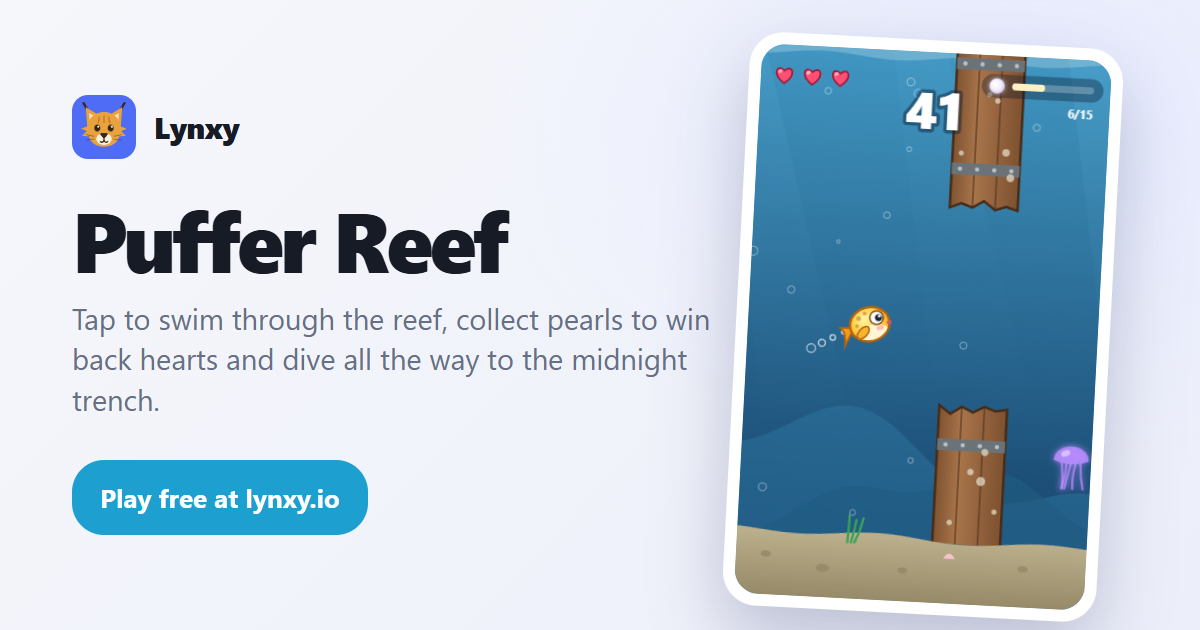
What a tap really does
A tap does not add a push to the puffer's movement. It sets its speed: whatever the puffer was doing, it is now swimming upward at a fixed speed. Gravity then slows it, stops it and pulls it back down, until it is sinking at a capped speed.
In numbers, one tap lifts the puffer about 58 units and brings it back to where it started after just under six tenths of a second. Two consequences follow:
- Two quick taps are not a double jump. The second tap simply resets the climb. Tapping fast makes the puffer rise steadily; it does not make it leap.
- Holding your height takes about 1.7 taps a second. Tap every 0.6 seconds and the puffer bobs around one level. Faster, it climbs; slower, it sinks.
Where to swim in the gap
The puffer is 26 units across, so in the widest gap it has 146 units of room, and in the narrowest 110. One tap's 58-unit rise uses about two fifths of the first and half of the second.
That arithmetic gives you a simple plan: ride the lower half of the gap and tap when you are just above the bottom column. A tap from there tops out around the middle, far from the upper column, and gravity brings you back down gently at first. If you swim through the upper half instead, every tap risks your head, and the only way to fix a mistake is to wait - which feels terrible and costs hearts.
The one place you are safe up high is the surface. The puffer cannot leave the water, but touching the surface does not hurt. The sand at the bottom does.
How the reefs get harder
Four things change as you swim, and all of them change slowly:
| At the start | Around reef 60 | |
|---|---|---|
| Swimming speed | 138 | 196 (reached around reef 65) |
| Gap height | 172 | 136 (the narrowest) |
| Distance between reefs | 214 | 196 |
| Time between reefs | ~1.55 s | ~1.0 s |
Time between reefs is the number to remember. At the start you have a second and a half per reef, enough for two or three taps and a moment to read the next gap. Late in a dive you get one second - roughly one and a half taps. There is no time to correct a bad line between reefs any more. You have to leave one gap already lined up for the next.
The gaps also move. Each one can sit up to about 160 units higher or lower than the one before. A drop of 160 is easy: stop tapping and let gravity work. A climb of 160 takes several taps in quick succession, and that is the hardest moment in a late dive. When you see a high gap coming after a low one, start climbing early.
The four waters
| Reefs | Water | What is new |
|---|---|---|
| 0-14 | Sunlit Shallows | Coral columns, wide gaps, slow water |
| 15-34 | Kelp Forest | Some gaps drift up and down |
| 35-59 | Sunken Wreck | Broken timbers; jellyfish from reef 45 |
| 60+ | Midnight Trench | Basalt and glowing crystals; the narrowest gaps |
Drifting gaps (from reef 15) move up and down while you approach. Do not aim for where the gap is when you first see it; watch which way it is moving and aim for where it will be.
Jellyfish (from reef 45) float between the reefs, always about 100 units off the straight line from one gap to the next. That is deliberate: a puffer swimming the direct line is safe. The jellyfish only catch you when you wander - typically after a big climb that overshoots.
Hearts, pearls and continues
You have three hearts. A bump against a reef, a jellyfish or the sand costs one; the puffer puffs up and blinks for two seconds, during which nothing can hurt it again. The blinking never ends while you are inside a column, so a bump in the middle of a reef will not be followed by a second one in the same reef.
Hearts come back in two ways:
- Pearls. About a quarter of the gaps hold a pearl, and now and then a string of three lies on the line between two gaps. Every 15 pearls fill the pearl string, which turns into a heart as soon as you are missing one.
- Heart bubbles appear every 20 to 31 reefs. If your hearts are full, a bubble gives five pearls instead.
Pearls in a gap are free - you are swimming through anyway. Strings of three between gaps are a different matter: they sit on the line from one gap to the next, so they are usually safe to take, but do not leave a good line to chase one. A heart is worth fifteen pearls, not the other way round.
When the last heart is gone you can start a new dive or continue for free. A continue clears the reefs around the puffer, gives all three hearts back and keeps your score; it waits for your tap before anything moves. You get two per dive. Take the pause seriously: shake out your hand, then tap when you are ready, not when you feel you should be.
The short version
- Ride low in the gap; tap just above the bottom column.
- Find your rhythm early: roughly one tap every 0.6 seconds holds you level.
- Leave each gap lined up for the next one, especially after reef 60.
- Start climbing early when a high gap follows a low one.
- Swim the straight line through the wreck and the trench; the jellyfish stay off it.