
Snake strategy on a 17 × 17 field
Snake is the simplest game on Lynxy and one of the hardest to play well. Early on, the danger is the walls. Later, the danger is you: a snake of eighty segments on a 17 × 17 field takes up more than a quarter of it. Here is how the field, the speed and the bonus star work, and the habits that keep a long snake alive.
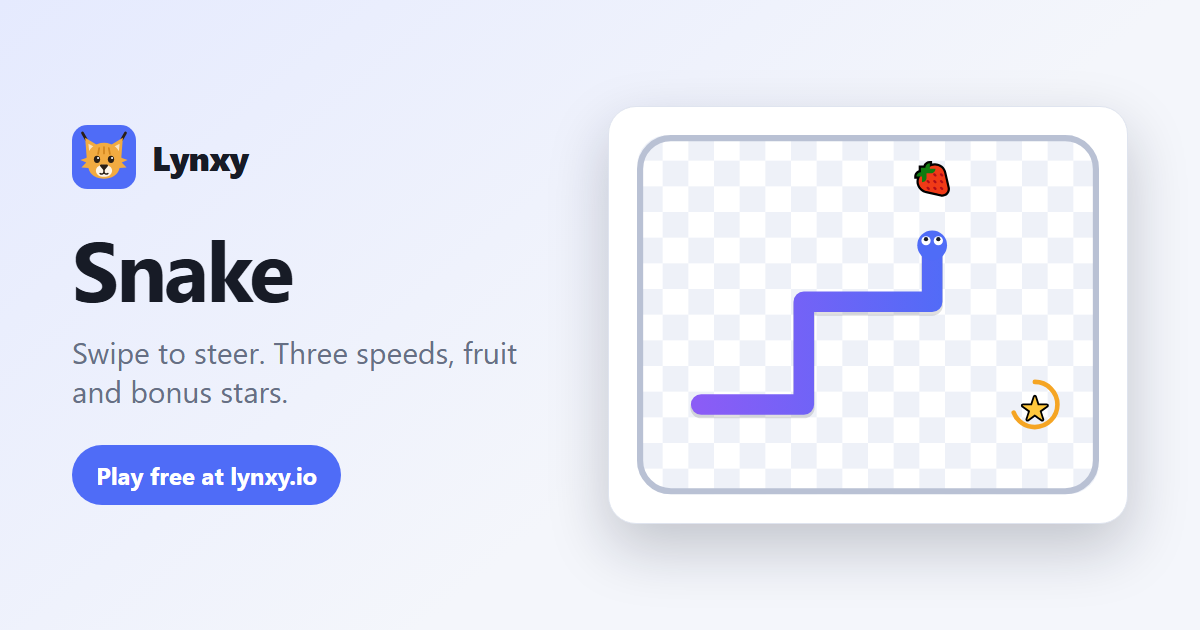
The field
The field is 17 cells by 17: 289 cells in total. The snake starts three segments long in the middle. The walls are solid - running into one ends the game - and so is the snake's own body, with one important exception: the cell its tail is leaving. The tail moves away on the same step as the head moves forward, so you can safely follow your own tail one cell behind it. (When the snake eats on that step, it grows and the tail stays put, so the exception does not apply.)
Up to two turns are remembered between steps, so a quick U-turn - right, then down, then left - is never swallowed by the game. A turn straight back into the snake's neck is simply ignored.
Speed and points
| Level | One step | Speed | Per fruit | Bonus ⭐ | Cells you can travel in 6 s |
|---|---|---|---|---|---|
| Easy | 165 ms | ~6 cells/s | 1 | 5 | 36 |
| Medium | 115 ms | ~9 cells/s | 2 | 10 | 52 |
| Hard | 78 ms | ~13 cells/s | 3 | 15 | 76 |
The last column needs explaining. After every fifth fruit a bonus star appears, worth five fruits, and it stays for six seconds of play with a ring that counts down. The field is the same size on every level, but the snake is faster on Hard - so it can cover more ground before the star disappears.
The furthest apart any two cells on the field can be is 32 steps (corner to opposite corner). On Hard, 76 steps in six seconds means you can reach any star on the field with time to spare, even taking a detour around your body. On Easy you get 36 steps: enough for a star in the far corner only if the way is clear. That leads to a slightly surprising conclusion: the bonus is easiest to catch on Hard. On Easy, a star on the other side of your own body is often not worth chasing.
Early game: the walls
While the snake is short, the walls are the only real danger, and they are mostly a matter of attention. Two habits help:
- Turn early near a wall. At 13 cells a second on Hard, waiting until the head is one cell from the wall leaves you less than a tenth of a second. Turn two or three cells out.
- Take the direct route. With a short snake you can go straight for every fruit. This is the part of the game to bank points quickly - the board will not be this empty again.
Late game: your own body
As the snake grows, the game changes completely. The question is no longer “how do I get to the fruit” but “will I still have a way out after I eat it”. Most long games end in one of two ways: the snake cuts the free space into two parts and ends up in the smaller one, or it turns into a pocket with no exit.
The habits that prevent both:
- Move in tidy back-and-forth rows. A snake that lies in neat parallel lines wastes no space between its segments. A snake that wanders leaves single-cell gaps you can never use again.
- Keep one big open area. Before you cut across the field for a fruit, ask whether the move would split the free cells into two. If it would, go around.
- When in doubt, follow your tail. The cell behind your tail is always about to become free. If you are boxed in, steering towards your tail buys time until the body moves out of the way.
- Do not chase every star. A star is worth five fruits, which is a lot - but not worth a risky dive into a corner surrounded by your own body.
Why a perfect game is impossible on this field
There is a famous way to play Snake that never loses: follow a fixed route that visits every cell of the field once and returns to where it started, over and over. The snake can grow until it fills the whole route, because the head is always following the tail.
On a 17 × 17 field that route does not exist. Colour the cells like a chessboard: every step moves from a light cell to a dark one or back, so any closed loop visits light and dark cells equally often - and an even number of cells in total. The field has 289 cells, an odd number. The best a closed loop can manage is 288 cells, leaving one out. So the “perfect” strategy tops out one cell short of a full board - and, in practice, it would take a very long time to get there, because following a fixed route means ignoring the shortest way to every fruit.
For real games, a looser version of the idea works well: once the snake is long, lay it out in rows across the field and leave a corridor along one side to come back through. You are still taking shortcuts to fruit, but you always have a known way home.
Which level should you play?
Points per fruit triple from Easy to Hard, and the star is worth five fruits on every level. If you want points, Hard pays three times as much per fruit and makes stars easier to catch, at the cost of reaction time. If you want long games and a big snake, Easy gives you time to think about the late game, which is where Snake is at its most interesting.
A good way to learn is to play Medium until a snake of 40 or 50 feels comfortable, then move up. The late-game habits are the same at every speed; Hard just gives you less time to apply them.
← All guides