
Star Prospector: a trader's guide to the fifteen systems
Star Prospector looks like a shooter, but underneath it is a trading game. Laser time, fuel and, above all, cargo space are what you are really managing. Get those right and the fifteen systems fall one after another; get them wrong and you can spend twenty minutes in Cinder Belt hauling iron to a planet that does not want it.
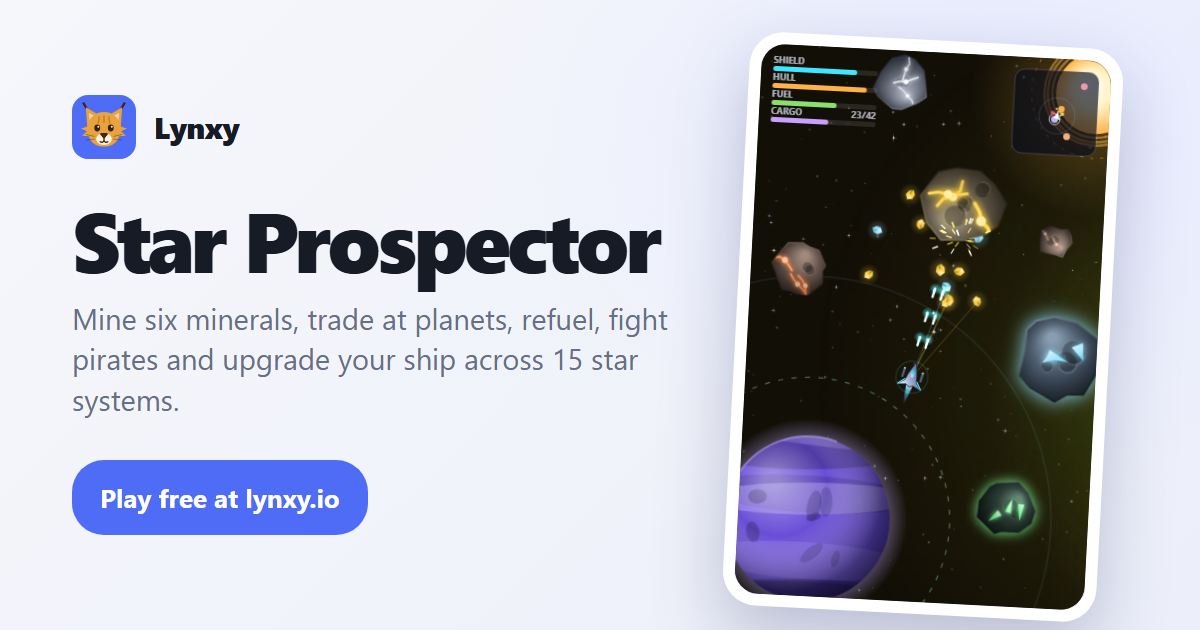
Everything below comes from the game's own data file - the same numbers the ship, the planets and the pirates use. Where we give advice, it is advice we would follow ourselves.
Your hold is the bottleneck
The stock ship carries 20 chunks of mineral, and every chunk takes one slot whatever it is made of. That single fact decides almost everything. A chunk of xenite is worth fourteen chunks of iron, but it costs you exactly the same space:
| Mineral | Base price | Best buyer | Paid there | Full stock hold (20) |
|---|---|---|---|---|
| Iron | 8 | Mining colony | ~11 | ~220 |
| Copper | 14 | Mining colony | ~19 | ~380 |
| Silver | 24 | Ice world | ~32 | ~650 |
| Gold | 40 | Frontier outpost | ~58 | ~1,160 |
| Platinum | 65 | Tech world | ~91 | ~1,820 |
| Xenite | 110 | Tech world | ~165 | ~3,300 |
Prices drift by a few percent either way from planet to planet, so treat the right-hand columns as a guide, not a promise. The market screen marks unusually good prices with ▲ and tells you which planet in the system pays best for each mineral - read it every time you dock.
Once you know that the hold is the limit, a few habits follow on their own. Do not fill up with iron "because it is there" when there is silver two fields further out. Do not fly home with half a hold. And if the hold is full of iron when a gold rock breaks open next to you, it can be worth dumping the cheap cargo by selling it first and coming back.
Rare rocks are tougher, but not tough enough to skip
Precious rocks take more hits. A gold rock has 1.75 times the hit points of an iron rock of the same size, and xenite 2.6 times. That sounds like a reason to stay with the easy stuff, until you divide the price by the toughness:
| Mineral | Toughness | Credits per unit of laser work | |
|---|---|---|---|
| Iron | 1.0× | 8.0 | |
| Copper | 1.2× | 11.7 | |
| Silver | 1.45× | 16.6 | |
| Gold | 1.75× | 22.9 | |
| Platinum | 2.1× | 31.0 | |
| Xenite | 2.6× | 42.3 |
Per second of shooting, xenite pays more than five times what iron does, and it fills the hold fourteen times more slowly. The only real cost of the rich rocks is where they are: further from the first planet and closer to the suns, which is also where the pirates and the gravity are.
Sell to the right planet
Each of the five kinds of planet wants different things, and the gap between the best and the worst buyer is bigger than most players expect. A tech world pays one and a half times the base price for xenite; a mining colony pays three quarters. Twenty chunks of xenite are worth about 3,300 credits at one and about 1,650 at the other - the price of a whole upgrade, lost by docking at the nearer planet.
- Mining colonies want iron and copper and sell cheap fuel. Good for the first systems.
- Ice worlds like silver and sell the cheapest fuel in the game, but repairs there are dear.
- Frontier outposts pay the most for gold and a little extra for everything, but charge half as much again for fuel and repairs. Sell there, refuel somewhere else.
- Tech worlds pay best for platinum and xenite, repair cheaply and have a shipyard.
- Trade hubs pay a fair price for everything and have a shipyard. Never the best buyer, never a bad one.
What to buy first
You start with 150 credits, and the first level of most upgrades costs between 150 and 450. The economy was tuned that way on purpose: the first full holds should already buy something that makes the next trip better. Each further level costs roughly three times the one before, so the late levels are things you save for.
Our order for the first few systems:
- Cargo hold (250). 20 slots become 30 - every trip after that is worth half as much again. Nothing else pays for itself as quickly.
- Tractor beam (200). The range goes from 30 to 70. You stop flying circles around loose chunks, and rival miners steal fewer of them.
- Laser power (300). 10 damage becomes 14 - 40% more per bolt, so a rock that took ten seconds now takes about seven.
- Engines and fuel tank. Once you start working the outer fields, fuel becomes the limit. The stock tank holds 100 units, and full thrust burns one per second.
Shields and hull can wait until the pirates get serious. Raiders, with their homing missiles, arrive in the fifth system (Pale Harbour); gunships in the ninth (Marrow Deep). Have a few shield levels and a missile rack by then.
Suns: the free slingshot that can kill you
A sun pulls with a force that grows sharply as you get closer. At its strongest, near the glowing corona, the pull is a little stronger than the stock engine can push - 300 against 220. With stock engines, if you let the ship drift into that zone you will not burn your way out in a straight line. You need to be moving sideways already.
Two engine upgrades (220 → 270 → 320 thrust, 1,500 credits in total) are enough to beat the pull outright. Until then, treat suns as a slingshot: come in fast and at an angle, let the gravity bend your path, and leave on the other side with more speed than you had. It saves fuel, and the richest rocks in every system sit near the suns anyway.
Docking and fuel
You dock automatically when you enter a planet's dashed ring below 170 units per second. The stock ship's top speed is 360, so you need to lose more than half of it. The cheapest way to do that is to turn around early and burn once, then coast in. Coasting is free; only thrust burns fuel.
Fuel gets more expensive as you go: service prices rise by 8% with every system. By the last system a unit of fuel costs more than twice what it did at the start - and frontier outposts charge almost three times what ice worlds do. With a 400-unit tank, filling up at the wrong planet late in the game can cost a thousand credits more than it should.
Fighting for money
Every pirate you destroy pays a bounty, and bounties count towards the system's target just like sales do. They also grow faster than anything else: 15% per system, against 12% for enemy hit points and 7% for their damage. Late in the game, fighting pays better than it looks.
| Enemy | First seen | Bounty in system 1 | Bounty in system 15 |
|---|---|---|---|
| Pirate fighter | System 2 | 90 | ~280 |
| Pirate raider | System 5 | 240 | ~740 |
| Pirate gunship | System 9 | 650 | ~2,020 |
| Rival miner | System 2 | 150 | ~470 |
Rival miners are a special case. They never attack first; they only fight back once you have shot them. Destroying one pays a bounty and drops whatever it was carrying, which can be a handsome hold of ore. Whether that is fair play is between you and your conscience.
A gunship in Marrow Deep has close to a thousand hit points. With the stock laser (10 damage, three bolts a second) that is more than half a minute of continuous fire. With laser power, cooling and a twin laser it takes a few seconds. Guided missiles do 90 damage plus 15 for every level of laser power, and lock on to hostile ships before anything else, so a full rack is the easiest answer to a gunship.
Losing the ship
If the hull reaches zero, a salvage tug takes you back to the last planet you docked at. The fee is small: 70 credits in the first system, 490 in the last. You keep your credits and every upgrade. What you lose is the cargo - and late in the game a full hold of platinum is worth five thousand credits or more.
So the rule is simple: sell before you go hunting. If you are going to pick a fight with a raider pack or fly close to a sun, do it with an empty hold.
How long a career takes
We tuned the economy with an autopilot that plays the whole game: it mines, fights back, sells at the best planet it can reach and buys upgrades. It needs about 50 minutes of game time for all fifteen systems, finishing with almost every upgrade bought and never sitting on a pile of credits it cannot spend. Every system takes it three to five full holds. A human pilot takes a few times longer, which is how it should be - the autopilot does not stop to look at the nebula.
← All guides